Monday brief
The Mandarin Duck – The World’s Most Beautiful Duck
More than 120 different types of ducks can be found around the world, but few are as visually striking as the Mandarin duck.
Silas Vaughn
Desk note
Brief tip
The full sticky-note brief continues below on the Monday desk.
Board
Desk Notes
More than 120 different types of ducks can be found around the world, but few are as visually striking as the Mandarin duck.
Male Mandarin ducks are especially famous for their brilliant and highly varied plumage, which makes them almost impossible to overlook. Although their populations have declined in some areas, these birds remain popular around the world because of their remarkable ornamental appearance.
In many Asian cultures, Mandarin ducks have also become an important symbol of affection, partnership, and loyalty.
What Do We Call Them?
The Mandarin duck, scientifically known as Aix galericulata, is called “yuanyang” in Chinese.
The Story of Ying Mei and Yuan Ge
The Chinese term “yuanyang” refers to a remarkable pair, and it can also be used to describe a couple whose personalities or appearances seem unusual or unlikely to match. The expression is connected to a traditional story about an unexpected pair, a gardener named Yuan Ge and Ying Mei, the daughter of a government official.
Yuan Ge was employed by Ying Mei’s father to perform work around the family’s garden. During a festival one day, Ying Mei found herself in danger after falling into a lotus pond. Yuan Ge immediately jumped into the water to rescue her, but her father misunderstood the situation and believed Yuan Ge was attempting to take advantage of his daughter.
As punishment, Yuan Ge was imprisoned. One evening, Ying Mei secretly went to the prison and brought him a beautiful, brightly colored robe. The guards witnessed the visit and reported it to her father, making him furious.
He ordered Yuan Ge to be thrown into the pond with stones fastened to his feet. Heartbroken by what had happened, Ying Mei followed him into the pond.
Several days later, two beautiful Mandarin ducks appeared swimming on the pond. The male displayed brilliant colors similar to those of the robe Ying Mei had given Yuan Ge.
Because of the birds’ striking appearance and the story surrounding them, people came to believe that the two lovers had been transformed into the pair of ducks.
What Do Mandarin Ducks Look Like?
Mandarin ducks are sexually dimorphic, meaning males and females have distinctly different appearances and can easily be distinguished from one another.
Males
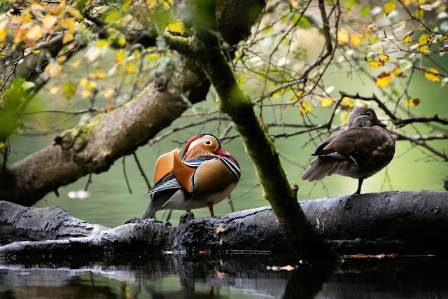
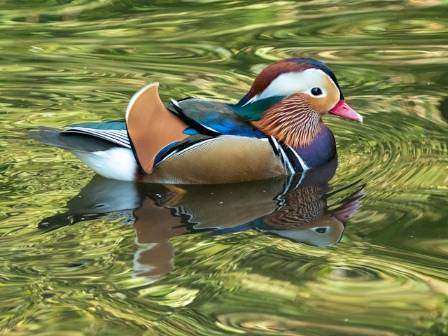
Male Mandarin ducks are exceptionally colorful. Their chests feature deep purple coloring combined with black and white markings. Their wings are primarily dark brown and are edged with blue-green feathers.
One of their most recognizable features is a pair of large raised feathers that extend upward from the wings like sails. They also have a prominent crown made up of brown and white feathers.
Bright orange markings can be seen across their cheeks, while their bills are vivid red with a small white marking at the tip.
The male’s elaborate coloration plays an important role in attracting females. During the breeding season, females tend to select males with the most impressive and vivid plumage.
Females
Female Mandarin ducks are much less brightly colored than males. Most of their bodies are covered in muted brownish-black feathers, although they have noticeable white markings around the eyes and throat.
Their bills are also considerably less colorful than those of males.
Both sexes have thin, flattened webbed feet that allow them to swim efficiently. When flying, however, males and females can both reveal attractive iridescent blue and green colors in their feathers.
Size
Mandarin ducks are medium-sized waterfowl. Their average body length is approximately 17.7 inches (45 cm), while their wingspan measures around 27.9 inches (71 cm).
Adults generally weigh between 1.15 and 1.39 pounds (520–630 g).
Mandarin Duck Chick Coloration
Young Mandarin ducklings have much more subdued coloring than adult males. In fact, their appearance is quite similar to that of ducklings belonging to many other species.
Their backs, wings, and chests feature mottled combinations of brown and yellow. Their faces are yellow, with a brown stripe extending over the crown.
A narrow brown line also runs from the rear of the eye toward the back of the head.
White Mandarin Ducks
Captive Mandarin ducks can display several different color mutations. The most frequently encountered mutation is the white Mandarin duck.
This variation may have resulted from repeated breeding between related birds combined with selective breeding, although the precise cause of the mutation has not been established.
As their name suggests, these birds are predominantly white, although the amount of white can vary considerably. Some retain markings similar to those of normally colored Mandarin ducks, but the patterns are much lighter.
Medium-brown feathers may appear across the crest, chest, portions of the wings, and the back. Other white Mandarin ducks are almost completely white, with only faint brown coloration visible on the chest or wings.
Where Can Mandarin Ducks Be Found?
Mandarin ducks are naturally distributed across eastern Russia, China, Japan, and Siberia. During the colder months, populations migrate toward southern China and Japan, where winter conditions are somewhat milder.
They can also be found in portions of Western Europe, although this region is outside their native range.
Where Do Mandarin Ducks Live?
Mandarin ducks favor temperate woodland and wetland environments. They strongly prefer areas close to water and frequently select nesting locations directly above bodies of water.
Their habitats can include rivers, streams, lakes, marshes, swamps, and bogs.
Most Mandarin ducks live in habitats located relatively close to sea level, although some populations can be found at elevations reaching approximately 5,000 feet (1,524 m).
These adaptable ducks are also commonly seen in suburban environments. They may live around towns, public parks, and even private gardens.
What Do Mandarin Ducks Eat?
Mandarin ducks are omnivorous and consume both plant and animal foods. Their diet can include seeds, small fruits, acorns, snails, insects, and small fish.
For much of the year, plant material makes up a larger portion of their diet. During spring and summer, however, they tend to increase their consumption of small animals.
How Do Mandarin Ducks Behave?
For most of the year, Mandarin ducks are social birds that gather into larger groups for feeding and travel. During the breeding season, they separate from these groups and form pairs.
In the eastern part of their native range, Mandarin ducks undertake substantial seasonal migrations. During winter movements, they can travel as far as 500 miles (804.7 km) in less than 24 hours.
Although they are not native to Western Europe, the introduced populations there tend to be relatively shy and unobtrusive. They often seek shelter in the shade beneath overhanging willow trees.
Because European populations originated from introduced birds, most of these ducks do not undertake the same migrations. Instead, many remain within roughly the same area throughout their lives.
Perching Ducks
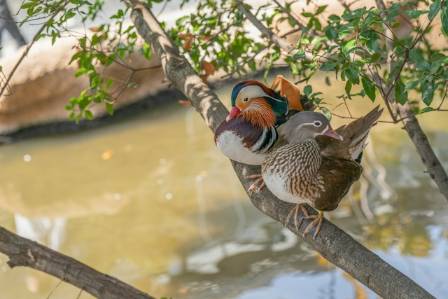
Mandarin ducks are classified as “perching ducks,” a group that includes species such as wood ducks. Unlike many other waterfowl, they are particularly comfortable climbing into trees and spending time high above the ground.
Communication
Mandarin ducks communicate using a variety of vocal sounds, including sharp quacks and high-pitched whistles.
How Do Mandarin Ducks Reproduce?
Mandarin ducks frequently remain with the same mate across multiple breeding seasons. Once a pair forms, the two birds may continue their partnership for several years.
Mating
Female Mandarin ducks are attracted to males with particularly bright and impressive plumage. Despite this, the female is the one that generally initiates the courtship process.
Their courtship display is elaborate and can involve movements such as shaking and mock drinking.
Actual mating in ducks can be forceful and may be unpleasant for the female. Mating takes place in the water, with the male mounting the female.
Unlike most bird species, female ducks possess a vaginal opening, while male ducks have a penis. During mating, the male inserts his penis into the female’s vaginal opening to transfer sperm.
Unwanted mating is common among ducks, and females have evolved a twisting vaginal structure that can make penetration more difficult.
Male ducks, in turn, have evolved a corkscrew-shaped penis that helps facilitate entry.
Nesting
When it is time to reproduce, Mandarin ducks search for holes in trees where they can establish their nests. The female ultimately selects the nesting site, although the male accompanies her during the search.
They prefer nesting locations well above the ground, where they are safer from many predators. Some nests may be positioned more than 30 feet (9.14 m) above the ground.
Before laying her eggs, the female lines the cavity with soft down feathers. She then produces approximately 9–12 eggs, laying one egg each day until the clutch is complete.
The eggs are oval and white, resembling the typical eggs of other duck species.
After all the eggs have been laid, the female incubates them for approximately 28–30 days. She spends roughly 80% of her time incubating and receives no assistance from the male during this period. During the remaining 20% of her time, she leaves the nest to find food for herself.
Once hatching begins, the ducklings generally emerge within only a few hours of one another.
Raising the Offspring
Although Mandarin duck pairs may remain together for several breeding seasons, males do not participate in incubating the eggs.
After hatching, the ducklings leave the nest almost immediately. They do this in response to calls from their mother, who encourages them to follow her.
Free-Falling
The way young Mandarin ducklings reach the ground from their high nests may look frightening, but this behavior is actually a normal part of their development and is also seen in many other bird species.
The mother begins by calling to her young from below. The ducklings respond by jumping from their nest, even when it is high above the ground.
After encouraging her offspring to descend, the mother leads them toward nearby water. Mandarin ducks often choose nesting cavities in trees that hang over water, so the ducklings usually do not have to travel far.
Once the family reaches the water, the father returns to join them and helps protect the young ducklings.
Maturity
Young Mandarin ducks generally remain with their parents for approximately 6–8 weeks, staying together until the ducklings develop the ability to fly.
After becoming capable of flight, the young birds leave their parents and either begin living independently or join another flock.
Even after leaving their parents, however, they are not yet sexually mature. Mandarin ducks generally reach reproductive maturity at approximately one year of age.
More from this board
NOTE · en

Eight Secrets of the Taj Mahal
For anyone visiting India for the first time, the Taj Mahal is an essential stop. This iconic mausoleum in Agra stands as India’s most celebrated monument and a timeless symbol of love. Commissioned by Mughal Emperor Shah Jahan between 1632 and 1647, it was built in memory of his beloved wife, Mumtaz Mahal, who tragically died during childbirth. Despite its global renown, many aspects of the Taj Mahal’s history remain mysterious. Here are some intriguing insights about this marble masterpiece.
NOTE · en
6 Surprising Health Benefits of Walking Through a Forest
Recent studies suggest that even a short walk through the forest can significantly reduce anxiety and improve overall well-being.
NOTE · en
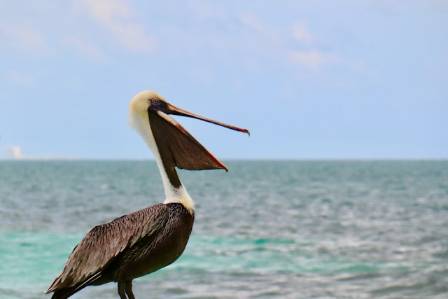
A bird flying close to the water's surface
Pacific Coast brown pelicans form breeding colonies from Baja California northward to California’s Channel Islands, with nesting activity occurring mainly during winter and spring. Once the breeding season ends, many birds migrate north. A small number remain visible in Monterey Bay throughout the year, but most individuals arrive during summer and remain in the area until early autumn.
NOTE · en

Czech Cubism, Permanent Exhibition of the Museum of Decorative Arts in Prague (Rewritten & Expanded)
Returning to a city you love is like turning the page of a book you never finished—there are always new chapters to explore, hidden corners to uncover, and stories to learn that didn’t make it into your initial visit. On a recent return trip to Prague, this sentiment felt particularly vivid. While my first visits had been filled with the iconic sights—the Charles Bridge at dawn, the grandeur of Prague Castle, the winding lanes of the Old Town—this time, I was fortunate to have a local guide by my side, someone who knew the city’s artistic pulse beyond the well-trodden tourist paths. It was through this guide that I stumbled upon the Permanent Exhibition of Czech Cubism, a self-contained treasure trove nestled within the Museum of Decorative Arts in Prague. Housed in the legendary House at the Black Madonna (Dům U Černé Matky Boží), this exhibition isn’t just a collection of artworks; it’s a portal to a pivotal moment in Prague’s cultural history, when the city emerged as one of the most important centers of the Cubist movement outside of Paris. What makes this experience even more extraordinary is that the exhibition itself is set within a Cubist masterpiece—a building that embodies the very principles of the art form it showcases. In this expanded exploration, I’ll delve into the history of Czech Cubism, the unique characteristics that set it apart from its Parisian roots, the highlights of the exhibition, and why this underrated gem deserves a spot on every art lover’s Prague itinerary.
NOTE · en

The Best RV for Large Families
Whether your family has one child or three (or more), the key to a smooth and enjoyable camping experience is selecting the appropriate RV. Start by identifying which RV type fits both your family size and budget.
NOTE · en

A Home That Reflects Artistic Boldness: Inside Jenn Lewis’s Vibrant West Harrison Residence
When mixed media artist Jenn Lewis moved into her new home in West Harrison, she envisioned a lively, welcoming space that could balance family life with her expressive art. With help from interior designer Lynn Biase—her longtime collaborator—that vision came to life in a home filled with energy, color, and personal style. Known for her daring, graffiti-inspired artwork, Lewis brings a fearless creativity into everything she touches. “Jenn embraces bold choices, whether on canvas or in her interiors,” says Biase. With two teenagers and a love for hosting friends and family, Lewis wanted a home that was both functional and dynamic—a place where art and everyday living could coexist naturally.